LVDS vs MIPI vs eDP: How to Choose the Right Interface for Your Industrial LCD Display
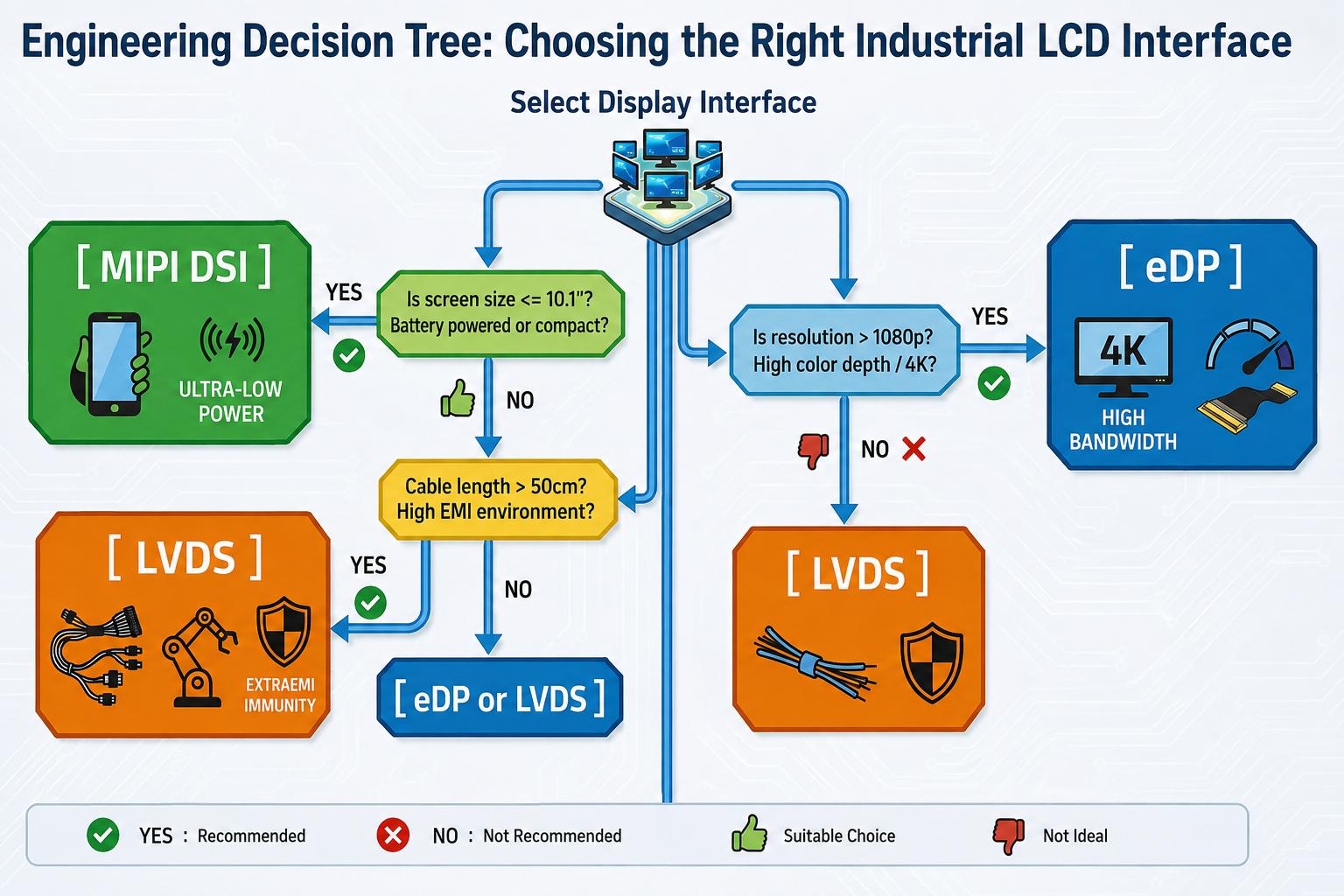
Selecting the right video signal interface is one of the most critical decisions during the hardware design phase of an embedded or industrial display system. The interface directly impacts signal integrity, power consumption, EMI/EMC compliance, cable harness costs, and system longevity.
Among the various display interfaces available today, LVDS, MIPI DSI, and eDP stand out as the three dominant standards in modern TFT-LCD display technology.
Key Takeaways (TL;DR)
Choose LVDS if you need long cable runs (up to 10+ meters), maximum electromagnetic noise immunity, or compatibility with legacy industrial systems.
Choose MIPI DSI for battery-powered, handheld, or compact smart devices under 10.1 inches where low power consumption and small form factor are top priorities.
Choose eDP for high-resolution displays (2K, 4K, or higher) in medium-to-large sizes (11.6 to 31.5+ inches) requiring high bandwidth and minimal wire count.
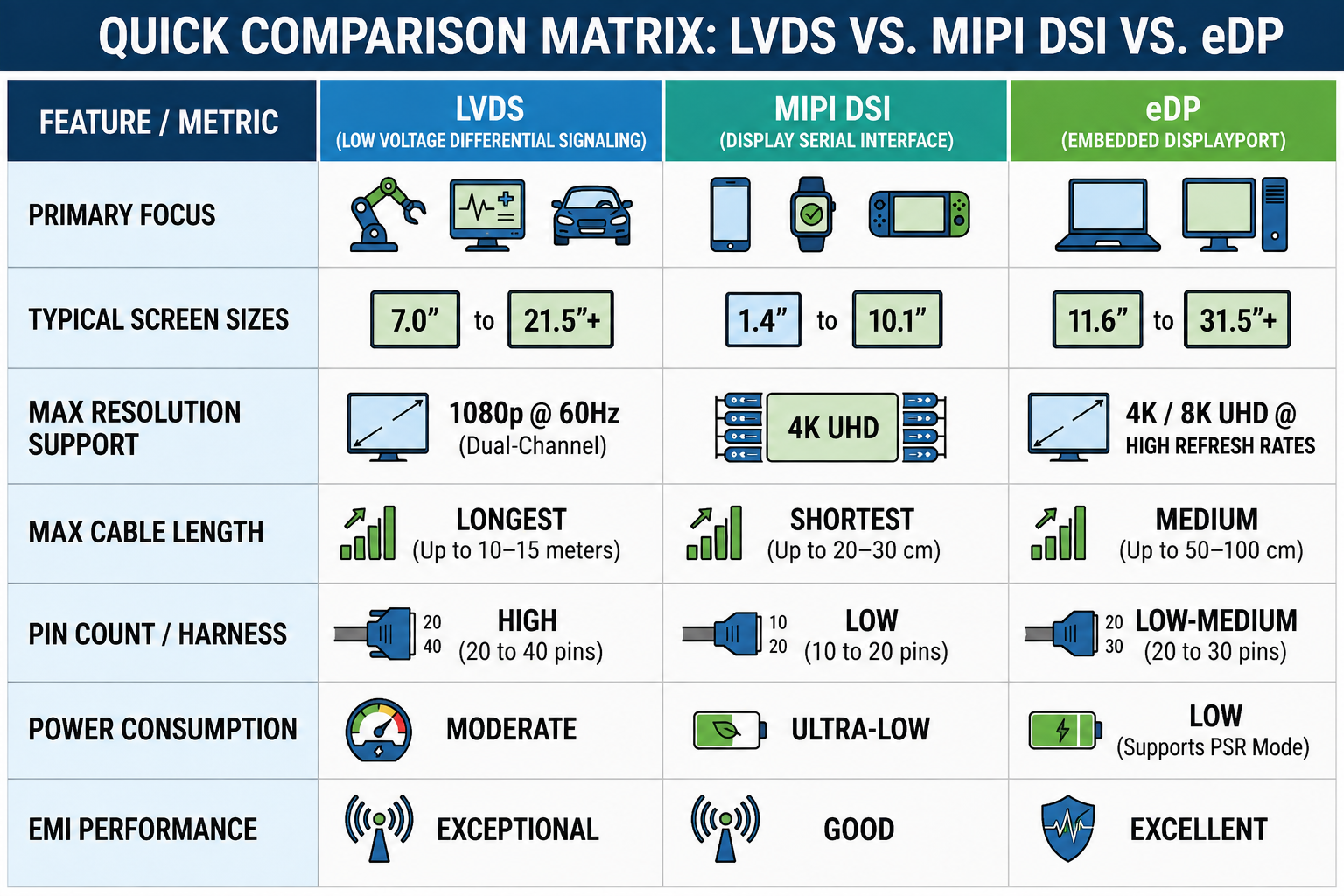
Quick Comparison Matrix
Deep Dive: Understanding Each Interface
1. LVDS (Low Voltage Differential Signaling)
The Workhorse of Industrial Automation
LVDS has been the industry standard for industrial displays for decades. It uses low-voltage differential signals to transmit high-speed data across copper cables, making it exceptionally resilient to electrical noise.
Pros:
Unmatched EMI Immunity: Ideal for noisy industrial environments (e.g., near motors, high-voltage relays, or medical imaging equipment).
Long Transmission Distance: Can reliably transmit video signals over long ribbon cables or harness assemblies without severe degradation.
Long Lifecycle & Market Availability: Controller boards and mainboards natively supporting LVDS are widely available and supported for 10+ years.
Cons:
Bulkier Cable Harnesses: Requires double or quad differential pairs plus power and ground, leading to higher wire counts (20-pin to 40-pin connectors).
Bandwidth Limitations: Struggles to support high refresh rates at resolutions above 1080p without complex multi-channel configurations.
2. MIPI DSI (Display Serial Interface)
The Champion for Compact and Mobile Devices
Maintained by the MIPI Alliance, DSI was developed specifically for mobile phones and tablet computers. It focuses on reducing pin count and power draw to maximize battery performance and save PCB space.
Pros:
Ultra-Low Power Consumption: Dramatically reduces system heat and extends battery life in handheld devices.
Minimal Board Footprint: Uses fewer signal traces, allowing ultra-thin flexible printed circuits (FPC).
High Pixel Density: Perfect for small-format high-PPI displays (e.g., smart home controllers, medical handhelds, POS terminals).
Cons:
Short Trace/Cable Distance: High-speed differential lines suffer from attenuation if routed over longer cables (typically limited to under 30 cm).
Complex Driver Integration: Host processors often require specific initialization sequences and driver tuning.
3. eDP (Embedded DisplayPort)
The Performance Leader for High-Definition Displays
Based on the VESA DisplayPort standard, eDP was developed to replace older LVDS interfaces in laptops and modern all-in-one PCs. It utilizes AC-coupled differential lanes capable of massive data throughput.
Pros:
Extreme Bandwidth: Effortlessly handles 2K, 4K, and 8K resolutions at high color depths (10-bit) and 60Hz+ refresh rates.
Reduced Wire Count: Fewer signal lines compared to LVDS for equivalent resolutions, resulting in lighter, thinner cables.
Advanced Power Management: Features Panel Self Refresh (PSR), which freezes the display engine when showing static images to conserve power.
Cons:
Higher Mainboard Cost: Requires system chips with native DisplayPort output capabilities.
Strict PCB Layout Constraints: High-speed lanes demand precise impedance matching (100-ohm differential) during layout.
Engineering Decision Tree: How to Choose for Your Project
At Samfong, we specialize in designing and manufacturing industrial-grade TFT-LCD modules, custom touch assemblies, and optical bonding solutions. Whether your project demands a high-noise-resistant LVDS panel for medical devices, a low-power MIPI screen for handheld instruments, or a high-resolution eDP display for outdoor digital signage, our engineering team is here to assist you from initial prototyping to mass production.
Custom FPC & Connector Adaptations
High Brightness Enhancements (Up to 2,000+ nits)
Wide Operating Temperatures (-30°C to +80°C)
📩 Contact Samfong Display today to request a custom LCD quotation or discuss technical specifications with our hardware engineers: www.samfong.net